
Orange Public Records by Custodian
No single office holds every Orange record. City files, county land records, Superior Court cases, and state certificates each follow a separate access path. An online index may confirm that an item exists, but that does not always mean its image is open on the web. The table separates those two ideas and leads with the channel most likely to work.
| Record Set | Keeper | Online Route | Public Access |
|---|---|---|---|
| Deeds, liens, maps | Orange County Clerk-Recorder | RecorderWorks from 1982 | Free index; images by office or mail copy |
| City files and permits | City Clerk and Building Division | Posted files, NextRequest, Maintstar | Permit history after 1989; older files by request |
| Civil and criminal cases | Orange County Superior Court | Separate systems by case type | Summaries vary; official copies from court |
| Assessment and tax data | Assessor and Treasurer-Tax Collector | APN, address, tax and GIS tools | Assessor does not return owner names online |
| Birth, death, marriage | County Clerk-Recorder, HCA, CDPH | County order workflow and state forms | Copy type and eligibility rules apply |
| Custody information | OC Sheriff and CDCR | County system and CIRIS | Current data with portal limits |
Several categories are closed or sharply limited. Juvenile, adoption, sealed, protected-address, and confidential family material is not broadly open. California also restricts individual voter data, motor-vehicle personal data, confidential marriages, and identifying details in vital records. A courthouse terminal or counter can provide broader access than a web portal in some case types, but it does not override a statute or sealing order.
RecorderWorks Indexes Orange Records
RecorderWorks is the Orange County Clerk-Recorder's free grantor-grantee index for recorded property documents from 1982 forward. A grantor transfers an interest; a grantee receives it. Search results can show a party name, document type, recording date, and document number. Select a document number, then a linked name, to see other indexed documents tied to that person. The public site is an index, not a library of document images.
| Field | Input | Required | Format or Choice |
|---|---|---|---|
| Search mode | Tabs | Choose one | Name, document number, type, map, date |
| Name role | Selector | No | All, grantor, grantee, or both |
| Person name | Text | For name mode | Last name, space, first name |
| Partial match | Checkbox | No | Useful for initials and spelling variants |
| Date range | Date pair | No | MM/DD/YYYY through MM/DD/YYYY |
| Document type | List | No | Deeds, liens, maps, notices, powers and more |
For an official copy, first record the document number. Copies cost $1 per page plus $1 to certify each document or map. Mail requests need a self-addressed stamped envelope. Clerk-Recorder staff do not perform the underlying search by phone, mail, or at the counter, so the index reference is a key part of the copy request.
The official Orange County copy instructions show the split between finding an index entry and ordering the full record.
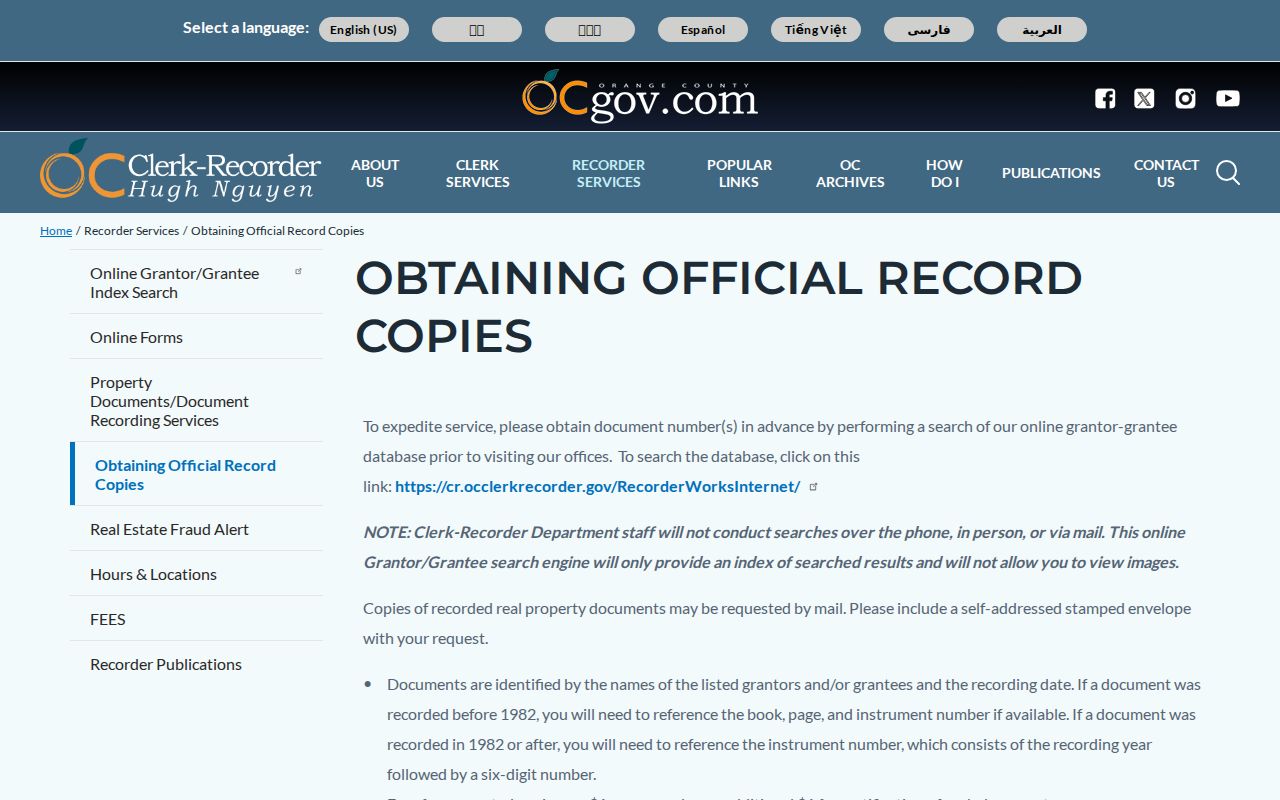
The captured instructions reinforce why a document number and the correct office or mail channel matter before payment.
Older Orange Records Cross Two Cutoffs
Orange has two different online cutoffs. RecorderWorks begins with county recorded documents from 1982. City permit and property history in Maintstar begins with properties constructed after 1989. A 1970s property can therefore require a Clerk-Recorder book, page, or instrument reference for the deed trail and a City of Orange public-record request for permit history. The dates describe different systems, so one should not be used as a substitute for the other.
Pre-1982 deed research can continue through Clerk-Recorder offices and Orange County Archives. For early city property work, Orange also links tax assessment rolls from 1900 through 1934. Old Towne, Plaza, and Eichler district properties may add planning and historic-preservation files to deeds and permits. This geography matters because exterior changes and designated resources can leave a municipal record even when the modern permit portal is incomplete.
Note: Orange County did not exist before 1889, so earlier land research may lead to Los Angeles County, rancho, or land-grant records.
Orange Court Records Split by Case
Orange County Superior Court divides online access among civil, criminal and traffic, family, probate, and small-claims systems. A person or business name search exists, but it requires free enrollment and sign-in. The registered user's own name can be checked through the free Search Me route. Criminal and traffic access instead expects a full case number and reCAPTCHA, while its calendar search offers justice center, courtroom, prosecutor, and hearing date fields.
The court says its files date to 1898, yet online depth varies. Unlimited and complex civil summaries begin in 1996, limited civil summaries in 2005, and most civil document images begin in 2008. Older records, certified copies, and files absent online require a justice-center counter, public terminal, or Form L-3009 request. Regular copies cost $0.50 per page, certification costs $40 per document, and a clerk search lasting more than ten minutes costs $15 per name.
The Orange criminal and traffic case search demonstrates the case-number and calendar routes.
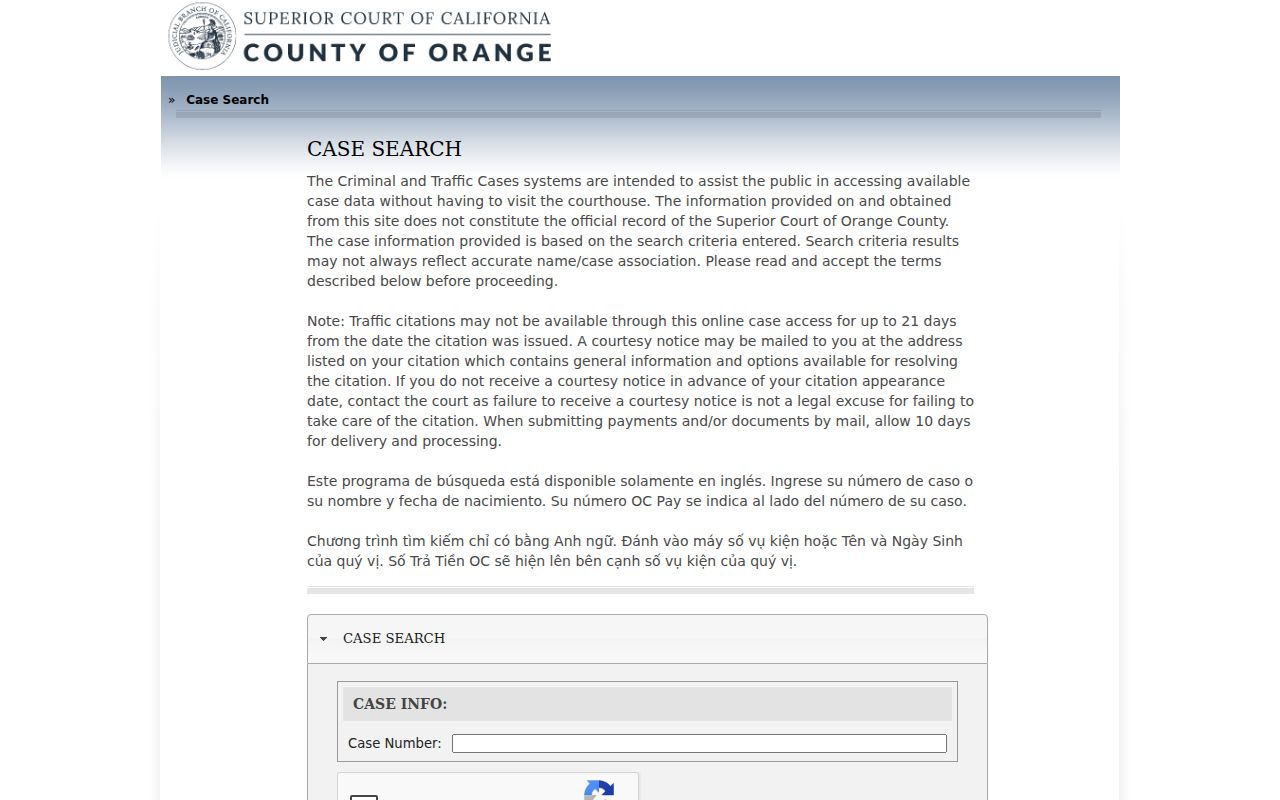
The screen also warns that web data is not the court's official record, making the clerk copy path important when accuracy or certification is needed.
Orange Property Records Without Names
The Orange County Assessor's secured-value tool requires an eight-digit Assessor Parcel Number, or APN. An APN is the county's parcel identifier. The office states that owner-name searching is not allowed by law and that owner names are not returned. This makes the tool useful for values and parcel facts, but not for typing a person's name. The public counter at 500 S. Main Street in Orange provides assessment information and property characteristics within legal access limits. The Assessor property information page identifies those online services and the local counter fallback.
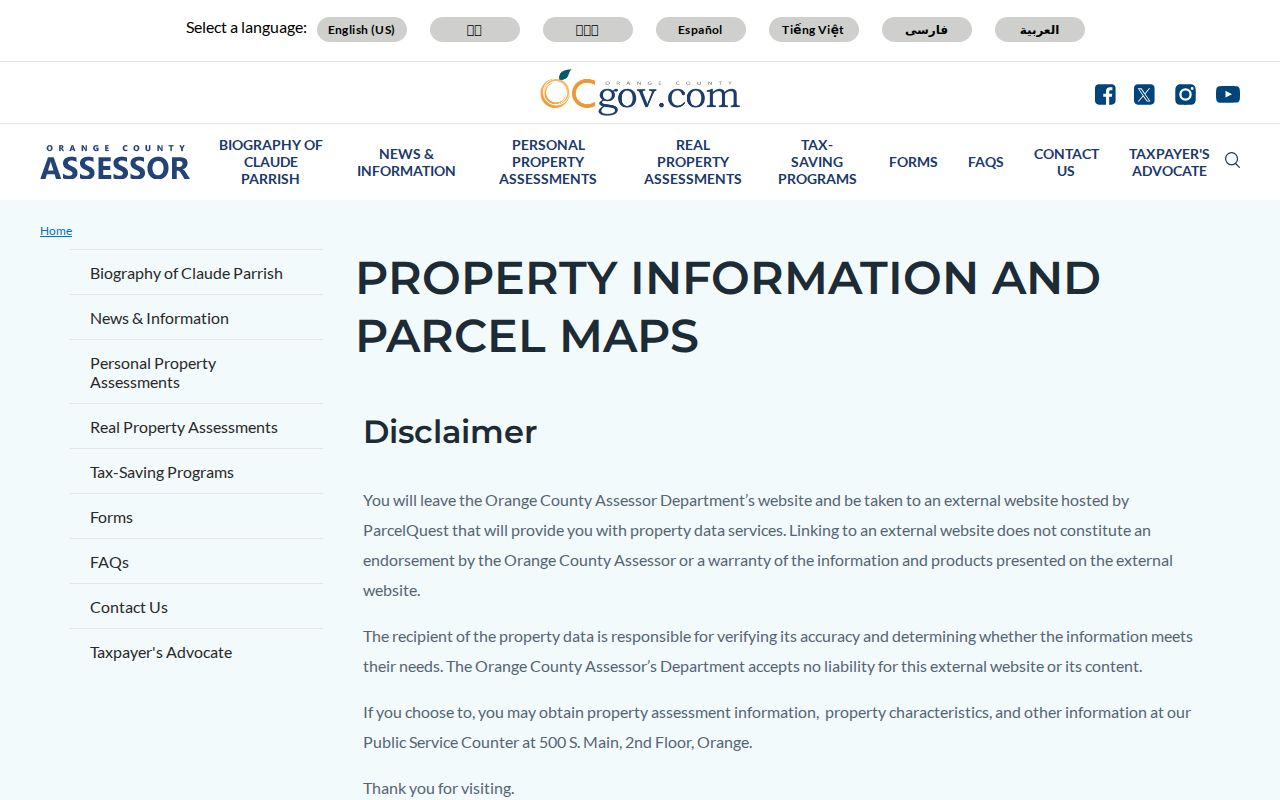
The screenshot distinguishes the Assessor's parcel tools from RecorderWorks, which accepts grantor and grantee names. A street address can instead lead through the Treasurer-Tax Collector and GIS tools. Tax search accepts a parcel number, property address, tax lien number, or watercraft or aircraft registration. It provides current and prior tax bills, delinquency status, and payment history. Do not assume an owner or mailing address appears unless a returned bill displays it. The Orange County tax bill portal shows the supported property and account routes.
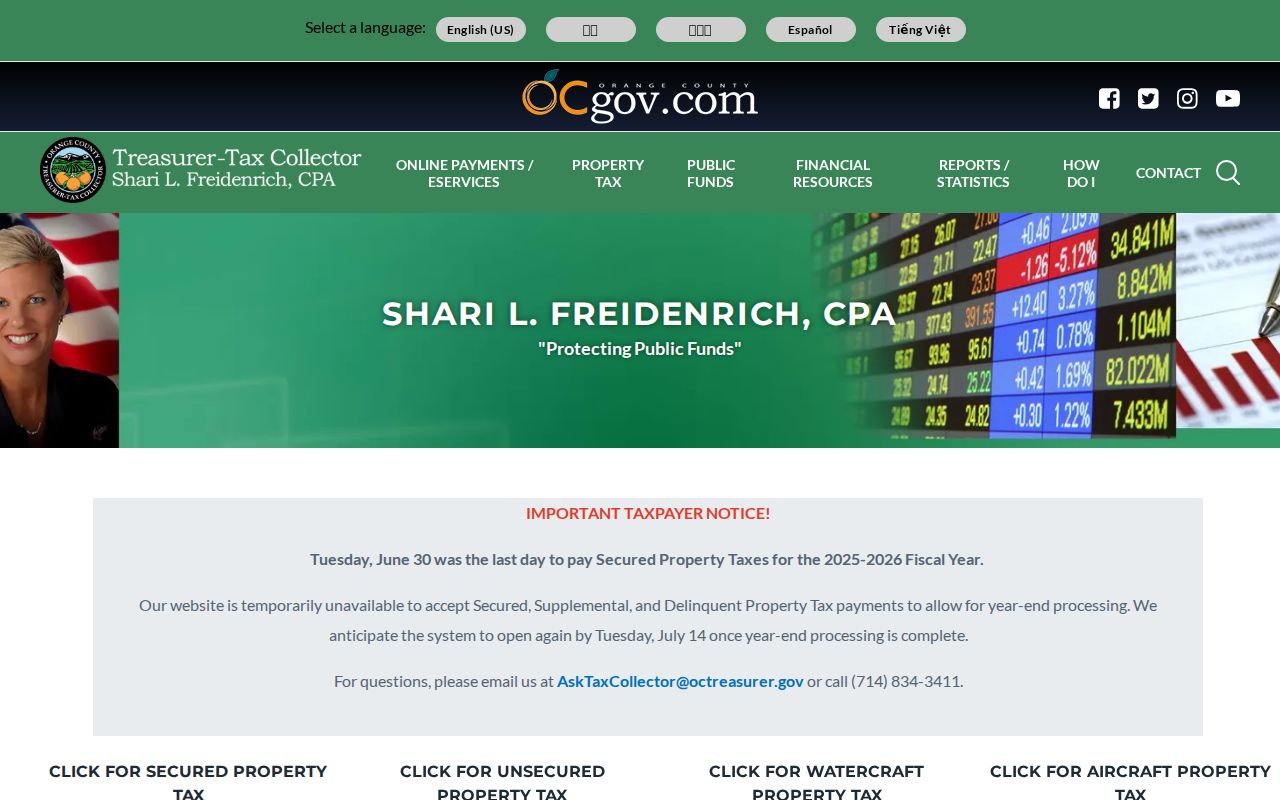
That address and parcel route can supply the APN needed for assessment or deed research without promising a prohibited owner-name lookup.
Orange GIS Records Add Geography
OC Land Insights adds parcels, tracts, corner records, survey documents, and county property assets to the land trail. A tract is a mapped subdivision; a corner record documents a surveyed property corner. These sources help translate a modern street address into the legal geography used in deeds, maps, and older files. They are especially useful when a recorded document names a lot, tract, rancho, or map rather than a familiar address.
The OC Land Insights application presents these county survey and parcel layers together.
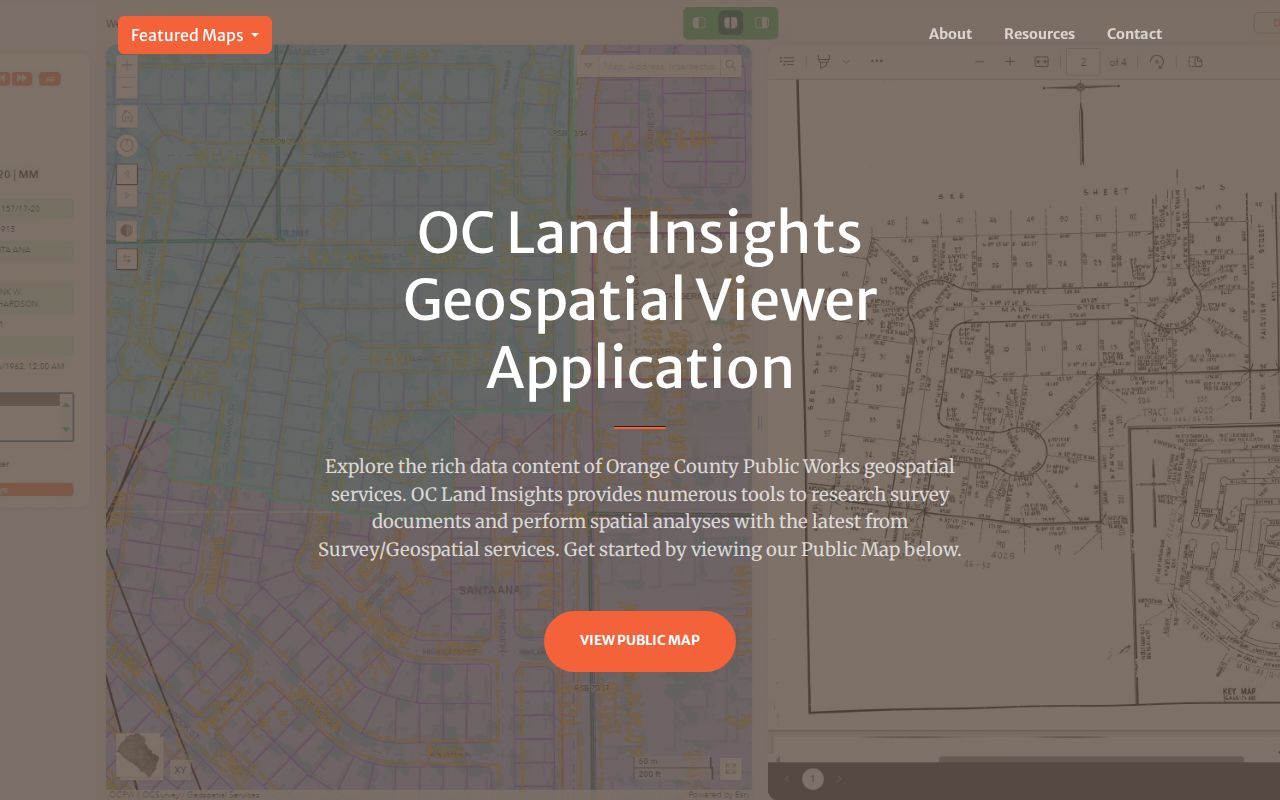
The GIS view supplies context, not proof of title. Confirm ownership changes through a recorded instrument and order the official copy when the full terms matter.
Orange Vital Records Have Copy Tiers
Orange County Clerk-Recorder issues county birth, death, public marriage, and confidential marriage records. Its web order workflow covers Orange County records only and requires pickup and payment in person. Customers must complete the application and bring valid government photo identification. The county generally issues certificates the same day when the record is available. The Health Care Agency registers local births and deaths before copies become available. The Orange County vital-document workflow moves through applicant, certificate type, record details, person, count, and finish steps.
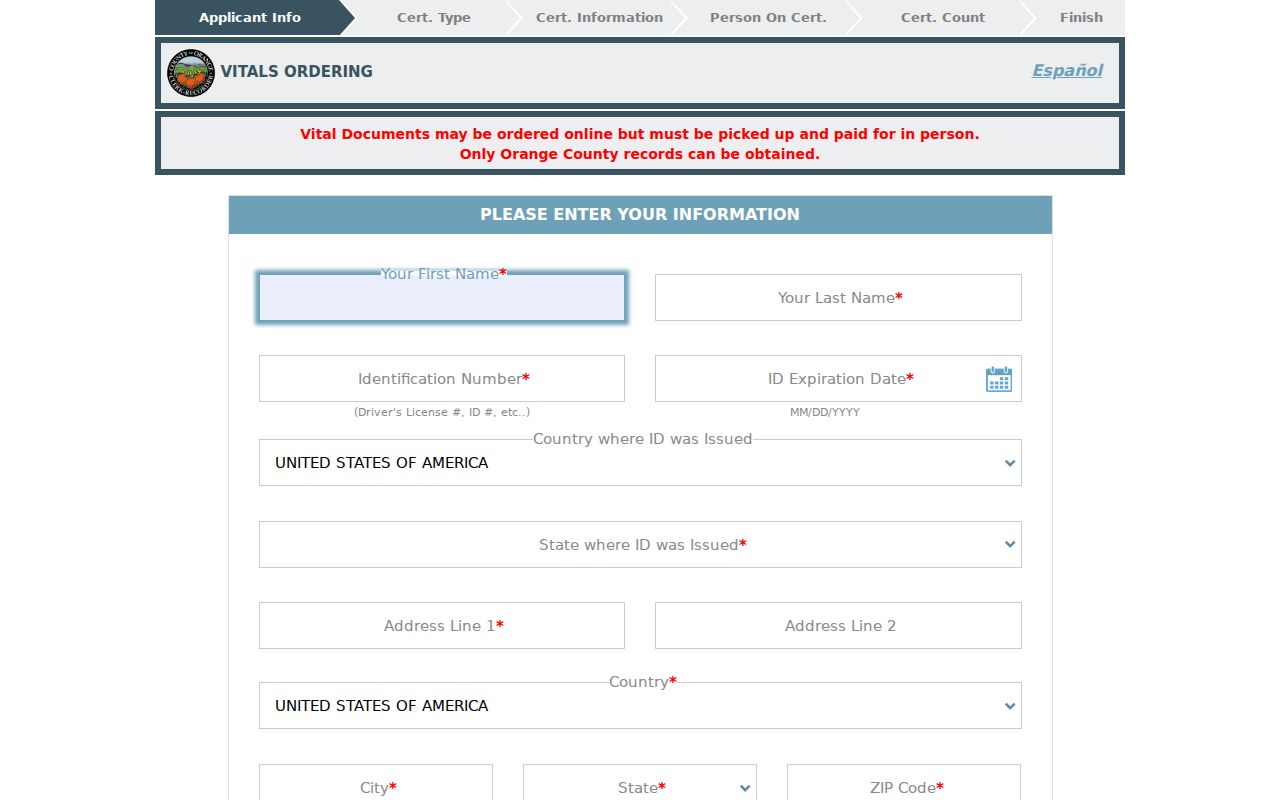
The staged form does not make the certificates an unrestricted index. It gathers the facts needed for the correct county copy and in-person pickup. Under California Health and Safety Code § 103526, an authorized copy can establish identity and requires authorized-person status plus the required sworn identity process. Informational copies of birth, death, and nonconfidential marriage records are available to other requesters and are marked as invalid for establishing identity. Confidential marriage records come only from the county where issued and generally go to the spouses or a person with a court order.
Fees changed in 2026. Orange County listed $34 for birth, $26 for death, and $19 for marriage certificates. CDPH listed $31, $26, and $19 for the same state-issued copy types. CDPH public marriage coverage has a gap from 2000 through 2007, so the county of issue is the better channel for that span.
Orange Public Records Offices
The right counter depends on the custodian. The City Clerk takes municipal requests. The Clerk-Recorder handles recorded documents and county certificates. The Assessor's main counter is physically in Orange, even though it serves the whole county. Calls can clarify procedure and availability, but the Recorder does not search deeds for callers.
Orange County Clerk-Recorder
601 N. Ross Street
Santa Ana, CA 92701
(714) 834-2500
Orange County Assessor
500 S. Main Street, 2nd Floor
Orange, CA 92868
(714) 834-2727
Weekdays, 8 a.m. to 5 p.m.
Assessor records requests also accept mail, in-person, and fax channels. Court files use the justice center that holds the case, and Orange Police records requests begin at the Police Records Bureau for involved parties with identification and the release form.
Orange Records for Heir Research
Probate, obituaries, death records, and unclaimed property form the strongest official trail for heir research. Orange County probate files can name a decedent, personal representative, heirs, fiduciaries, and related parties when those details are public. A death certificate or newspaper obituary can help separate people with the same name. Recorded deeds and trust documents can then show how a property interest changed.
Start with the Superior Court probate portal, then request the public case documents needed to confirm names and roles. Pair the file with the county or CDPH death record, local newspapers, cemetery sources, and the California State Controller's unclaimed-property search. Mental-health files, sealed material, and other protected probate content stay restricted. The goal is a supported chain of public facts, not a guess based on one index hit.
Note: A CDPH dissolution certificate is not the full court file, just as a RecorderWorks index result is not the full recorded instrument.
Orange Custody and Police Records
The Orange County Sheriff confirms that its Inmate Information System and booking log are online, but the current public version does not show inmate charges and the public services portal may require an account. California's CIRIS lookup covers people now in CDCR custody and can return a name, CDCR number, age, current location, commitment county, admission date, and parole-hearing information. CIRIS is a current-custody lookup, not the official records channel. A request for CDCR records follows the department's Public Records Act process.
City of Orange police reports are not an open name index. The Police Records Bureau releases reports to involved parties, who must bring valid identification and complete the release form; fees may apply. The counter is open weekdays from 8 a.m. to 6 p.m. and Saturdays from 8 a.m. to 2 p.m. For an Orange County Sheriff incident, call OCSD Records first to confirm that the report is available. City incidents generally begin with Orange Police, while county and Sheriff-jurisdiction incidents begin with OCSD.
California Closes Some Orange Records
Open-government law does not erase record-specific privacy rules. California withholds juvenile and adoption records, sealed case material, confidential family details, protected voter identifiers, motor-vehicle personal data, and addresses shielded through Safe at Home. The Assessor also limits some office records under state tax law. Redaction means a custodian removes protected details before releasing the rest of a record.
Individual voter registration information is not a general public index. Access to a voter file is limited to approved election, scholarly, journalistic, political, or governmental purposes, and protected voters and sensitive identifiers are excluded. For personal registration status, use the voter's own state lookup rather than attempting to obtain another person's file. The detailed restrictions and request process are covered with Orange voter registration records.
Lawful use. Use Orange records only for a legal personal, family, property, consumer-safety, or civic purpose. Never use a record to stalk, harass, threaten, or expose a protected person.
Orange Public Records Terms
A few terms prevent costly mistakes. An index can point to a record without showing the full document, while certification confirms that a copy came from the official keeper. California agencies may also cite an exemption for a part of a request while releasing the rest.
- Custodian
- The agency or office that keeps and releases the record.
- Index
- A searchable list of entries, often with names, dates, types, and reference numbers.
- Record image
- The scan or full view of the filed document, which may have separate access or fees.
- Certified copy
- An official copy authenticated by the keeper for uses that require proof of origin.
- Exemption
- A legal rule allowing or requiring the office to withhold protected material.
Ask whether the need is for an index result, plain copy, or certified copy before paying. The three products serve different purposes and may come through different channels.
California Deadlines for Orange Records
The California Public Records Act, Gov. Code § 7920.000 and following, applies to Orange city and county agencies. Under Gov. Code § 7922.535, an agency generally has ten days to decide whether it holds disclosable records responsive to a request. Written notice may extend that determination by up to fourteen days for unusual circumstances. The deadline is for the determination, not a promise that every record will arrive on day ten.
Fees generally cover direct duplication cost unless another law sets a special fee. Orange County states that standard printed PRA pages cost 15 cents each, electronic delivery can be free, and staff search time is not billed. A request can be anonymous, though the agency may need a non-identifying contact route to clarify the scope or deliver records. Inspection can also be arranged directly with the office.
Requesting Orange Public Records
A focused request helps the custodian locate the right files and apply the right access rule. State the record, department, date span, names, address, permit, case, parcel, or document number already known. Ask for electronic copies when that format works, and separate a request for records from a question that asks staff to research or explain events.
- Choose the keeper. Send city files to the City of Orange, recorded documents to the Clerk-Recorder, and case files to the Superior Court.
- Check the posted index. Save any document, case, APN, permit, or request number that can narrow the search.
- Describe existing records. Give a clear date range and subject without demanding that staff create a new report.
- Select the channel. Use NextRequest, the agency form, mail, fax, a counter request, or an inspection appointment as documented.
- Review the response. If the office seeks clarification, narrow the scope. If material is withheld, ask for the cited exemption and any releasable portion.
Recorder copies follow their own procedure rather than the general PRA price. Court copies and vital certificates also use statutory fee schedules. Confirm the expected amount before sending a check, and include the required envelope, identification, or sworn statement when that office calls for it.